

“I needed to do more”
That’s Mike Hermoza in the spring of 2020. The year the world went quiet, when work moved to the kitchen table, and for him the daily grind stopped being enough.
“There was very limited activity we could do,” he says. “That’s when I looked into New York Volunteers, and that’s when I saw that I needed to do more than just working remotely…which was a little boring.”
He went looking for somewhere to put himself. He found us and hasn’t left.
Six years later, Mike is our volunteer board treasurer. He gives every month. He shows up for the steady, unglamorous work that keeps an organization like ours standing — the kind nobody writes a newsletter about.
And he’s still doing more. On Sunday, September 27, Mike is running the half marathon at the Adirondack Marathon — a loop around Schroon Lake — with every one of those 13.1 miles dedicated to the dogs in our program right now.
He isn’t asking you to run with him. He’s asking you to fund a mile. A mile costs $60.
He came for the dogs. He stayed for the table.
Mike arrived with an obvious bias. “I love dogs. I have two of my own, a Westie and a Yorkie.” Suzy and Lia are regulars at our Funminster Pet Dog Show, and they’ve since appointed themselves his training supervisors, “monitoring me,” as he puts it.
But loving dogs is what got him in the door. Something else is what kept him.
At our 10-year gala, every table in the room was assigned one of our teams — a veteran or a person living with a physical disability, and the dog trained to work beside them. Mike and his wife spent that evening across from one of those pairs, listening while the man walked them through it: the application, the waiting, the two years of training that happened before the dog ever came home.
“Just seeing the story — the process for the application, the cost involved with the training,” he says. “And then when I look at that person and the dog? That, to me, is very meaningful.”
He’s seen the numbers. He gives anyway.
And there are a lot of them: the shelter fee, the vaccines, the vet visits, the food, the equipment, the training hours. About two years and roughly 2,000 of those hours stand between a shelter dog and a working service dog. Mike has a clearer view than almost anyone of how thin the margins get.
What he keeps returning to isn’t a figure at all. It’s where our dogs begin — every one of them out of a shelter, chosen for potential nobody else had the time to look for.
“Instead of the dogs being euthanized,” he says, “we are giving that dog purpose. We are giving that dog meaning — to be of service to someone that is reliant and could be dependent on that dog.”
He’s a monthly donor himself, and mentioned almost in passing that he’s about to raise his gift. He didn’t offer it as a talking point. We’re telling you because the person with the clearest possible view of our finances is also the person giving every single month.
“The funding and everything that we can get from outside donors is really driving the success for our organization,” he says. “There is a lot that goes into it.”
Why running
The running isn’t a stunt, and it isn’t new. Mike has run four marathons in the last five years — Australia, Argentina, London, Florida.
For him the miles do something.
“I definitely take it [running] as therapeutic stress relief,” he says. “From just being outdoors, taking nature in.”
Two years ago he ran a half marathon in Utah and turned it into a fundraiser for us. He has never once treated it as an obligation.
“Every marathon race or half marathon race that I’ve pledged for Nancy is never on the budget,” he says. “It’s always been kind of spontaneous, because I like doing it.”
He’s also clear-eyed about what he’s asking of you.
“I know how hard it is to ask people for money, with the economic turmoil that we’re in right now,” he says. “But when it comes to dogs, and any affiliation that dog owners have from just seeing something like this — it’s captivating.”
A mile costs $60
Every $60 funds one mile. That’s an “In Training” vest for a pup just starting out. Fund all 13.1 — $786 — and you’ve covered half a year of food and vet care for one dog in training.
- $25 — part of a mile. A training toy and a week of treats.
- $60 — 1 mile. An “In Training” vest and walking equipment.
- $120 — 2 miles. A vet visit and vaccines.
- $200 — 3 miles. Professional training.
- $500 — 8 miles. A full year of food.
- $786 — the whole race. Half a year of food and vet care.
Mike is emphatic about where it lands: “100% of the proceeds going to Putnam Service Dogs.”
And then there’s mile 14
Mike’s race ends at 13.1. His legs will be glad of it.
A service dog’s road is about two years long. When he crosses that line, our pups are still going — still learning, still eating, still growing into the vest.
That’s mile 14: the road that keeps going after the race is over. It’s why a recurring gift is the truest version of this. $60 a month funds a mile every month. Mike’s race lasts one day; a pup’s training lasts two years.
Why September
September is National Service Dog Month. It began in 2008 as National Guide Dog Month, the idea of the actor Dick Van Patten, who founded Natural Balance Pet Foods, and was later moved to September and widened to honor every kind of service dog, and every kind of person they work for.
The point of a month like this isn’t the hashtag. It’s that most people have never had a reason to think about what stands behind the dog in the vest: the shelter she came out of, the two years, the volunteers, the vet bills, the person who has been waiting.
A month is just an excuse to show you. We’ll be doing that all September — the dogs, the people they were matched with, and the ones still growing into the vest.
Mike is spending his time running around a lake.
What he’d tell you, if this is your first time here
We asked Mike what he’d say to someone whose entire introduction to Putnam Service Dogs is a man running around a lake. His answer wasn’t a pitch, and it was better than one.
Don’t take our word for it. Go look.
“People just have to see things visually,” he says, “instead of just a blog or a blurb or a message. You can see the success stories of all these recipients.”
The road that keeps going
Every dog we place started out as somebody’s last-minute decision at a shelter. Two years and about 2,000 training hours later, that dog is opening doors, picking up dropped keys, steadying someone on a staircase, and handing a person back their independence.
Mike has read exactly what that costs, and he’s spending part of his September running around a lake anyway. He’d tell you the running isn’t the point — that anyone can do a version of this. A 5K. A birthday. A skill you already have and would rather spend on something that lasts.
“There’s endless opportunities in this approach,” he says.
“Mike came to us because he was looking for something worth supporting that would add to his life,” says Nancy Teague, our founder and executive director. “Six years later he’s watching over our finances and running 13.1 miles for our dogs. That’s what showing up looks like.”
Run 13.1 miles with Mike. Then keep going for our pups in training.
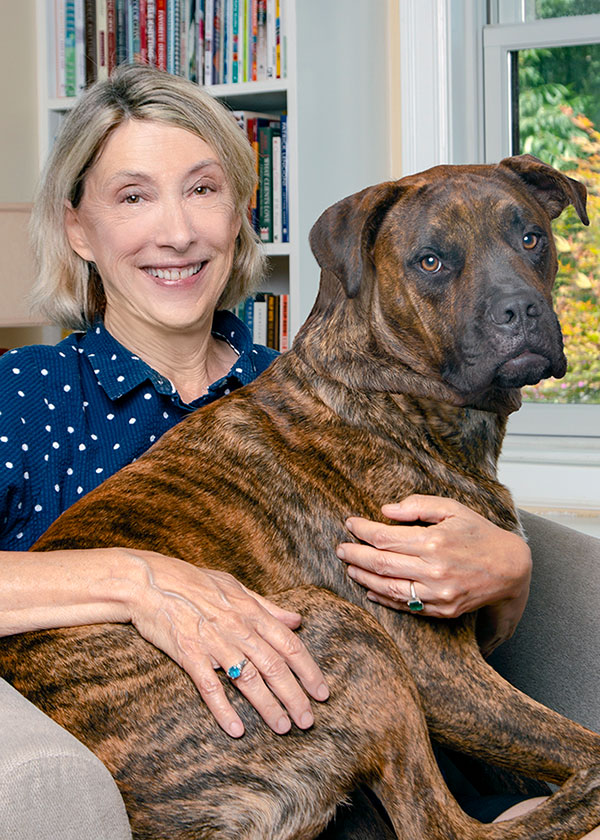
Nancy Teague, the founder of Putnam Service Dogs, is a dedicated advocate who embodies the mission of the organization every single day. Alongside the passionate individuals who have joined the cause, she works tirelessly to make a difference in the lives of both people and dogs. With an unwavering commitment to championing service dogs, Nancy understands the transformative power that occurs when a service dog is matched with its recipient, forging a remarkable team.